Social Safeguards and Gender Justice as the Cornerstone of Biodiversity Conservation in Cameroon
Baltazar Atangana, Gender Advisor and author, together with Paule Victoire Tchakounte, Expert in Gender and Social Inclusion, argue that biodiversity conservation in Cameroon cannot succeed unless social safeguards and gender justice are placed at the very heart of policies and practices.

When Biodiversity Protection Meets Community Rights
Cameroon, a cornerstone of the Congo Basin, is home to forests covering nearly 40% of its territory. These ecosystems serve both as vital carbon reservoirs in the global fight against climate change and as living spaces for millions of people. Yet conservation policies implemented since the 1990s have often marginalized local communities. The creation of national parks such as Lobéké, Boumba Bek, and Nki came with severe restrictions on access to forest resources, depriving populations of hunting, fishing, and gathering, without adequate compensation (CED 2022).
Social safeguards emerged as a response to these injustices. They are grounded in universal principles such as Free, Prior and Informed Consent, enshrined in the United Nations Declaration on the Rights of Indigenous Peoples (United Nations 2007). Within the REDD+ framework, Cameroon committed to applying social and environmental safeguards inspired by the Cancún Agreements (COP16 2010). These commitments require that every conservation initiative be accompanied by mechanisms for participation, grievance redress, and recognition of customary land rights.
Gender as a Critical Lens for Biodiversity Policy
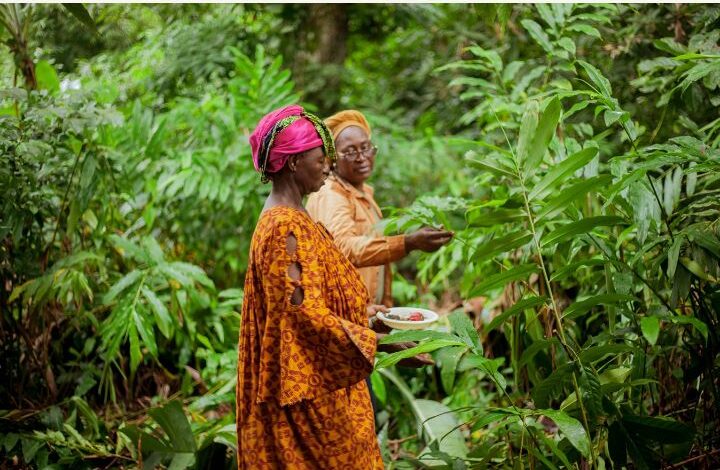
The integration of gender into conservation remains marginal, even though women play a central role in managing natural resources. They ensure food security through subsistence farming, collect fuelwood, and transmit traditional knowledge related to the forest. Yet they are rarely present in decision-making bodies, and their land rights are weakened by patriarchal customary norms.
Research in forestry and gender has shown that excluding women from governance processes leads to ineffective and unjust policies (Colfer and Minarchek 2013). In Cameroon, the absence of women’s voices in conservation projects exacerbates social inequalities and undermines community ownership (Sonkoue Watio and Mbimbe Nlom 2021). Compensation mechanisms often privilege men, thereby reinforcing asymmetries of power.
A gender-sensitive approach to social safeguards requires recognizing women as key actors in conservation, establishing inclusive participation mechanisms, and integrating their specific needs into compensation and alternative livelihood plans. It also demands a transformation of social relations, where women are no longer relegated to secondary roles but acknowledged as full partners.
Local Experiences Between Innovation and Resistance
In certain regions of Cameroon, community initiatives have attempted to integrate gender into conservation. Village Anti-Poaching Committees have gradually opened their ranks to women, who bring expertise in sustainable resource management. Community-managed hunting zones have also allowed women to participate in local governance, though their influence remains limited.
These experiences illustrate that social safeguards can be a vector of innovation. They also reveal cultural and institutional resistance that hinders the full integration of women. Customary norms continue to restrict women’s access to land, and compensation schemes often favor men. This situation demonstrates that social safeguards cannot be effective without a profound transformation of gender relations.
The Challenges of an Incomplete Governance Framework
The obstacles are manifold. Legally, Cameroonian legislation struggles to recognize customary land rights, leaving women vulnerable since their access to land often depends on marital status. Institutionally, community participation mechanisms remain dominated by men, limiting women’s voices in strategic decisions. Culturally, social representations continue to relegate women to secondary roles in resource management.
Scholars have highlighted the lack of coherence between national laws and international commitments (Chacgom 2019). The social safeguards required under REDD+ are difficult to align with Cameroonian forestry legislation, weakening their implementation. Added to this are financial and technical constraints that hinder effective monitoring, as well as incomplete institutionalization that undermines policy coherence.
Towards a New Alliance Between Biodiversity and Social Justice
For social safeguards to become a genuine lever of transformation, it is necessary to move beyond declarations of principle. Harmonizing national laws with international commitments on human rights and gender is crucial. Developing social and gender-sensitive indicators of success in conservation projects would allow for concrete measurement of impacts on communities, beyond ecological outcomes alone.
Promoting inclusive governance, where women and youth are recognized as full partners, is indispensable for embedding conservation within a framework of justice and sustainability. Strengthening women’s capacities through training, financing, and leadership mechanisms is a prerequisite for their full participation.
Social safeguards in Cameroon cannot be dissociated from gender justice. They are both an ethical imperative and a condition for the success of biodiversity conservation policies. By integrating women as central actors, recognizing their knowledge, and guaranteeing their rights, conservation can become a project of social and ecological transformation. In a country where the forest is both a global heritage and a vital space, gender-sensitive social safeguards are not optional; they are essential for ensuring that conservation becomes a shared endeavor, grounded in dignity, equity, and sustainability.
References
CED (2022) Protection of community rights
Colfer, C. J. P. & Minarchek, R. D. (2013) Women, Men and Forest Research: A Review of Approaches, Resource Tenure, and Rights. CIFOR
United Nations (2007) Declaration on the Rights of Indigenous Peoples
COP16 (2010) Cancún Agreements on REDD+ Safeguards
Sonkoue Watio, M. & Mbimbe Nlom, M. (2021) Community Conservation in Cameroon: Issues, Challenges and Perspectives
Chacgom, A. (2019) Legal Framework Analysis for the Application of REDD+ Social and Environmental Safeguards in Cameroon