Beyond Climate Change: The Lake Chad Basin as an Incubator for Gender Equality
In Cameroon’s North and Far North regions, at the heart of the Lake Chad Basin, climate and social challenges are deeply intertwined. Drawing on his regular work in the area, Baltazar ATANGANA, expert in gender and development, offers an analysis rooted in field experience, showing how these territories become living laboratories where justice, equality, and resilience are tested.

Across the Lake Chad Basin, particularly in Cameroon’s northern borderlands, we operate within some of the country’s most fragile institutional environments. Yet we know that the potential of these initiatives to catalyze gender equality and strengthen social systems remains largely underestimated. In governance and development debates, climate change is too often reduced to an ecological function—mitigating droughts, preserving biodiversity—while rarely acknowledged as a lever for social transformation and equity. Our reality shows the opposite : landscapes under stress reveal, with striking clarity, the structural inequalities we confront and the opportunities for reform we must seize.
When Climate Frontiers Become Spaces of Social Justice
Women and girls living in the border zones of the Lake Chad Basin face systemic vulnerabilities similar to those affecting struggles against gender-based violence, early marriage, or restricted access to resources. Nearly 30% of Cameroonian women aged 20–24 were married before the age of 18 (World Bank, 2018), a figure that underscores the persistence of gendered inequalities in rural areas. In under-resourced jurisdictions, nearly all cases—whether land disputes, domestic violence, or poaching—are handled by the same local authorities, without specialization or adequate means. Social justice often remains the last sector to receive significant investment, despite its central role in community resilience.
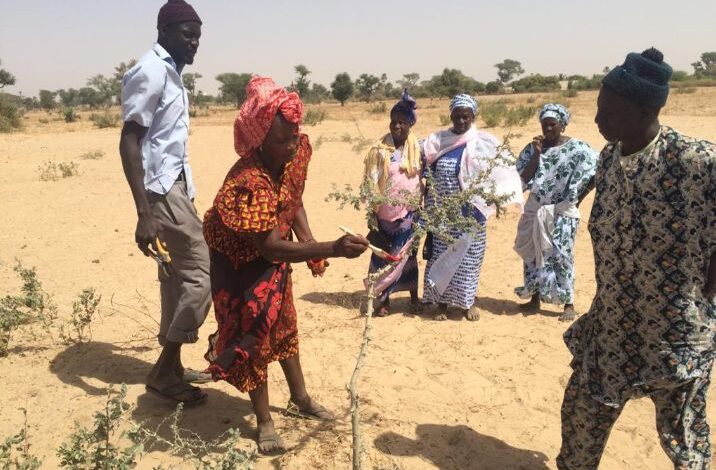
The consequences are visible on the ground. In areas such as Logone-et-Chari or Mayo-Tsanaga, women community leaders mobilized for sustainable resource management have become the only credible mediators. They compensate for institutional deficiencies, ensure social cohesion, and protect the most vulnerable. These everyday realities give actors a direct view of gender fractures and social fragility.
Landscapes as Incubators of Equality
In the Basin’s borderlands, local initiatives are often the only visible authority. They possess logistical capacity and responsiveness that social institutions lack. They have sometimes built trust with communities that state structures never sought to establish. Unlike short-cycle projects, certain organizations remain present for decades, granting them continuity and influence rarely seen in the field of gender equality.
This leverage remains underutilized. Yet history shows that one sector can serve as an entry point for broader reforms. Initial support for women in natural resource management in Niger led to more inclusive land policies. Funding for gender-based violence prevention introduced community mediation protocols, useful in other contexts. Climate initiatives in Chad generated advocacy platforms where women gained political visibility. Nothing prevents the Lake Chad Basin from playing a similar catalytic role.
Local examples abound: a village forest management committee in Diamaré where women are excluded from decision-making; a fishing cooperative on Lake Chad where girls lack access to income; or reforestation projects that ignore women’s traditional knowledge. These situations are not exceptional. Cameroon’s adolescent fertility rate remains extremely high at 107 births per 1,000 women aged 15–19 (World Bank, 2023), a statistic that directly intersects with questions of access, empowerment, and resilience. Similarly, average annual rainfall in northern Cameroon has declined by 2.9 mm per decade since 1960 (UNEP, 2020), exacerbating resource scarcity and intensifying gendered vulnerabilities in agriculture and water collection.
Small, targeted interventions—integrating women into local governance bodies, financing income-generating activities, recognizing indigenous knowledge—can transform perceptions and behaviors far more effectively than abstract awareness campaigns.
Used intelligently, the landscapes of the Lake Chad Basin can become incubators of gender equality—spaces where modest improvements are tested and refined before being scaled up. Few sectors are better positioned to demonstrate what practical and progressive strengthening of equality means in communities most in need. Recognizing this opportunity opens the path to durable and systemic reform, rooted in territories often considered peripheral but in reality central to the future of social justice and equality in Cameroon.
About the author
Baltazar ATANGANA, gender and development expert, author of Lutte de femmes (2025) and Lignes de résistance (2026), works on the links between equality, climate change, and financing women organizations for social justice in Africa. Contact : noahatango@yahoo.ca