The Fuel Ran Out. Not Every Girl Will Come Back
In late October 2025, a fuel blockade did what years of attacks on schools never had: it closed every classroom in Mali at once. The closure lasted two weeks. For girls, the real damage is what a break in schooling sets in motion at home, and a financing system that counts buildings cannot see it. By Baltazar Atangana and Dr. Nadi Albino

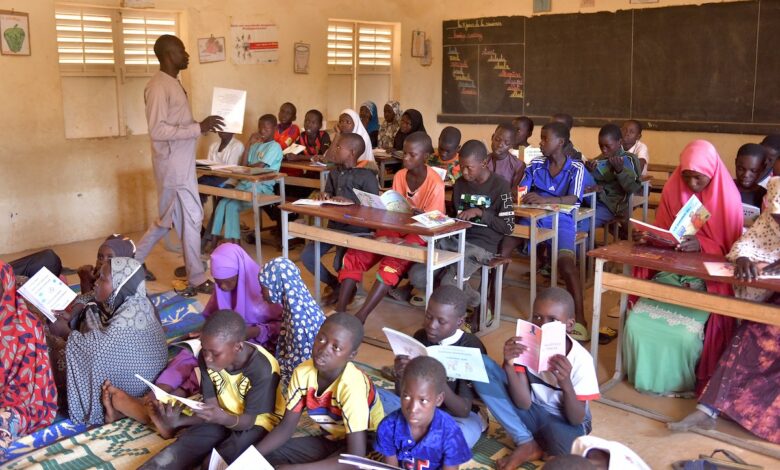
On 26 October 2025, Mali’s education minister announced that every school in the country would close for two weeks. None had been attacked that week. What emptied the classrooms, from the conflict zones of the north to the middle-class neighborhoods of Bamako, was diesel, or rather the lack of it. Since September, fighters from the al-Qaeda-linked group JNIM had been blockading fuel supplies, and by late October the shortage had stalled the trucks, buses and generators the school system runs on. The government cited fuel supply, not an attack on a school, as the reason. Classes began resuming on 10 November.
Two weeks sounds survivable, and for many children it was. But a deputy school director in Bamako told Human Rights Watch what anyone who has worked on girls’ education already knows: “A short break can have huge consequences.” For a girl from a household already under strain, a fortnight at home is long enough for her labour to become indispensable, for a marriage negotiation to begin, or for a bride price to start looking like the way through a lean season. A school can reopen in a day. A marriage, once contracted, does not reverse itself with the school calendar.
The blockade landed on top of an older emergency. As of June 2025, more than 600,000 students and over 2,000 schools across Mali were already shut by conflict. What October added was proof that a school system can be brought to a standstill without an armed group ever walking through a school gate.
That matters, because the policy conversation about girls’ schooling in the Sahel is still organised around two numbers: schools closed and attacks recorded. Both describe buildings. Neither can see what happens inside a household once a girl has been out of class for three weeks with nowhere to go. Every interruption carries that risk. Displacement multiplies it, because it is the interruption most likely to be long, to separate a girl from her school roll and her teachers, and to arrive at the moment her family is least able to feed her. Blockades lift and droughts end. Displacement is where a temporary break most often becomes a permanent one.
The Bride Price Behind the Numbers
Consider what the counts miss. In July 2025, in Yagoua, in Cameroon’s Mayo-Danay department, aid workers documenting the aftermath of floods along the Logone and Chari rivers met a teenage girl whose school latrines had been swept away. With nowhere safe to manage her period, she told them, she stayed home while her brothers kept going to class. In the weeks a family is displaced, the walk to fetch water can stretch from minutes to hours, and a girl’s exposure to harassment along the route grows with it. In Plan International’s research across the Sahel, a young woman in Mali described where that pressure leads: once a family can no longer provide for a daughter, marrying her early is what parents feel forced into. None of this appears in a school closure count. All of it eventually appears in a bride price.
This is also why the dominant donor story needs a caveat. Responses to the Sahel’s overlapping shocks have leaned on a tidy chain: climate change drives conflict, conflict drives displacement, so climate finance is education finance. The chain is not wrong so much as incomplete. Treated as a master narrative, it tends to produce large, top-down infrastructure projects timed to donor budget cycles, rather than the smaller, faster interventions that keep a displaced girl in class. Use the climate lens to explain why families move. Do not let it stand in for asking what happens to a girl once they have.
Not New, Just Unwired
The region is not starting from nothing. Most of what a response needs already exists; it simply is not connected. Radio-based distance learning has kept displaced children in Burkina Faso, girls included, linked to a curriculum for years; it is underfunded, not untested. Niger’s civil registration system, which one national registry official put at around six in ten newborns registered, up from about three in ten in 2007, is exactly the kind of infrastructure that could carry a portable school record across a displacement line, if someone builds the link. RELANCE, a regional education programme for Chad and Mauritania backed by the World Bank and Germany, signed US$137 million in financing agreements in July 2025 and is designed as an open platform that other Sahel countries can join. Its open schools, which combine digital learning with face-to-face support for young people outside the traditional system, are a ready-made vehicle for girls whose schooling has been broken. And school protection committees, where they function, are a ready-made way to track which girls stop turning up, rather than which buildings stop opening. None of this requires a new programme. It requires wiring what exists to reach a girl in the week she is displaced, not the year a new project is designed.

One part of that wiring is almost absent from the conversation: teachers, and specifically women teachers. Their presence is one of the levers most often associated with keeping adolescent girls enrolled, particularly where families hesitate to send daughters to schools staffed only by men. Yet when displacement hits, teachers face the same pressures as everyone else: families of their own to protect, and little reason to stay attached to a school that has stopped functioning. A serious plan has to include hazard pay, priority relocation and continuity of contract for women teachers who move with displaced communities, not only latrines and school kits for the girls they would otherwise be teaching.
The mobile money idea circulating in donor conversations, rapid cash grants timed to the moment a family is weighing an early marriage, is the right instinct with an unexamined assumption built in. The same research cited to justify it also documents limited digital and financial inclusion among exactly these girls. A grant offers no protection if it needs a phone, an account and an identity document that a displaced fifteen-year-old does not have. Route it instead through the lists that already exist, such as UNICEF and WFP cash transfer registries, women’s associations and school protection committees, rather than assuming individual phone ownership.
One Ask, One Number, One Deadline
There is also a governance fact this conversation keeps skipping. Burkina Faso, Mali and Niger, which had already formed the Alliance of Sahel States in 2023, formally left ECOWAS in January 2025. RELANCE, meanwhile, runs through Chad and Mauritania, neither of which belongs to the Alliance. A proposal for portable school credentials that simply calls for “regional coordination” asks a ministry official to trust an architecture that no longer exists as a single bloc. It has to name the body that would actually recognize a displaced girl’s record across a border, whether an examinations authority, a UN agency or a bilateral agreement, because the region is not currently one thing to coordinate with.
None of this is free, and making the case without a figure invites the obvious question. A programme that wires existing radio education, civil registration and school protection committees to reach displaced adolescent girls, with the retention of women teachers built in, is realistically a proposition in the tens of millions of dollars, not the hundreds of millions: smaller than RELANCE, and far smaller than a new multi-country infrastructure build. It needs one owner willing to convene the pieces, and one measure of success that is not “schools reopened”: the share of displaced adolescent girls still enrolled twelve months after displacement, tracked through a portable record tied to the civil registry rather than to a single school roll.
And there is a date. Education Cannot Wait, the global fund for education in emergencies, is seeking US$600 million for its 2027–2030 strategic plan through its Hope Starts Here campaign, with a High-Level Replenishment Conference in Geneva on 5 November 2026. A Sahel-specific, displacement-focused ask, aimed at the education ministries in Bamako, Ouagadougou and Niamey alongside Education Cannot Wait and the World Bank, therefore has both a venue and a deadline. It does not have to be an open letter to nobody.
The World Bank, the Center for Global Development and the Population Council have put a number on what is at stake: every dollar invested in adolescent girls’ empowerment in Africa could return more than tenfold, an estimated US$2.4 trillion in economic gains by 2040. That return depends on girls who are still in school. Sahelian girls are not leaving class because a metric failed to count a closed building. They are leaving because no one has wired the systems that already exist to reach them in the week they are displaced. Wire them, measure the right thing, and bring the ask to Geneva in November. That is how a projection becomes a plan.